
I was reviewing some documents this weekend for a Veteran who wanted to increase his disability rating and I noticed something disturbing. The C&P examiner that conducted his psychological interview had made a mistake— an error that I believe had a direct impact on the veteran’s disability rating.
The C&P examiner conducted the interview. He filled in all the required text boxes pertaining to the vet’s history before, during and after military service. Everything looked good to that point. So, check and check.
B-u-u-u-t, as I moved along the rest of the DBQ, I noticed that the examiner forgot something. He didn’t translate the symptoms he had gathered from his clinical interview into checks on the check boxes specifically called “Symptoms” on the DBQ form.
“Does that really matter?”
I believe so and I’ll explain why.
Look at the Mental Health DBQ “Section 3 Symptoms” below. I’m not showing you any VA trade secrets. You can download the entire form yourself by checking on the image below.
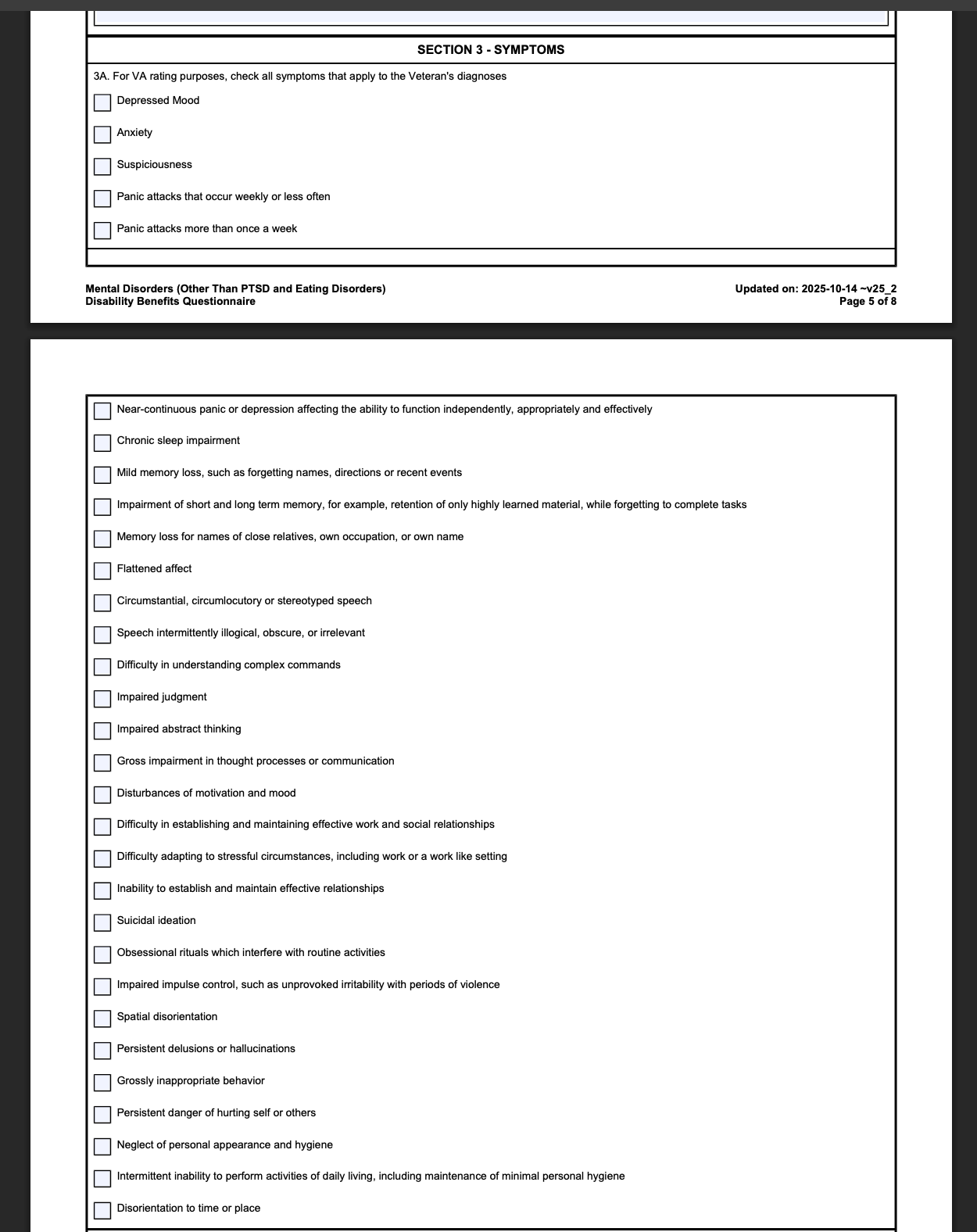
The VA clearly uses the symptoms you describe during your compensation and pension exam indicated by the checkboxes to determine how bad your condition is and, just as importantly, how much the symptoms are impacting your social and occupational life.
If you’ve ever received a ratings decision for a mental health condition from the VA, you know you get a paragraph that tells you how you met your current rating and another one that describes the next higher rating requirements. For example if you have a 30% Mental Health service connection, you see a paragraph that reads like this directly below it that reads something like:
“A higher evaluation of 50 percent is not warranted for a mental disorder unless the evidence shows occupational and social impairment with reduced reliability and productivity due to such symptoms as:
• Flattened affect
• Circumstantial, circumlocutory, or stereotyped speech
• Panic attacks more than once a week
• Difficulty in understanding complex commands
• Impairment of short- and long-term memory (e.g., retention of only highly learned material, forgetting to complete tasks)
• Impaired judgment
• Impaired abstract thinking
• Disturbances of motivation and mood
• Difficulty in establishing and maintaining effective work and social relationships. (38 CFR 4.125, 38 CFR 4.126, 38 CFR 4.130)
How the symptoms are used by the VA to decide a rating:
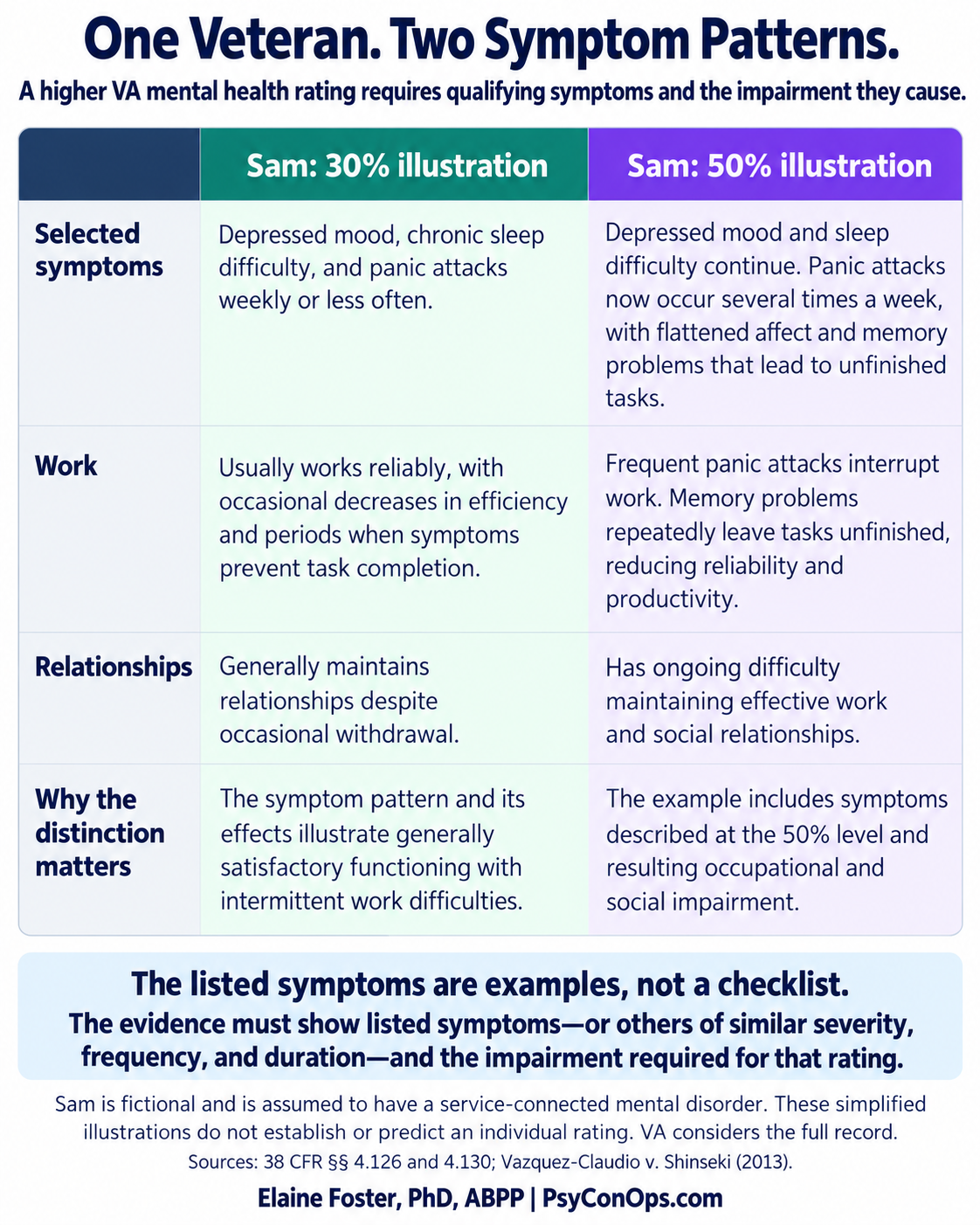
Here’s A Made-Up example to drive home the point: (Sam is a fictional character created for this post).
Imagine we are looking at a DBQ completed by a psychologist who works for XYZ VA contractor who performs C&P examinations for the VA. Our veteran’s name is Sam. Sam has trouble sleeping 5 out of 7 nights, he feels down most days, and sometimes, he has trouble starting tasks.
The VA looks at the symptoms and asks: how many symptoms does Sam have and how do these problems get in the way of Sam’s work and relationships?
30% rating: Sam has a few symptoms that cause some trouble. Sam sometimes works more slowly, and now and then. He has days when working is very hard. But most of the time, Sam still does a good job.
If Sam’s symptoms grow. For example, he experiences memory problems, sleep disturbance, irritability, sad mood, or obsessions and compulsions . Then we can check off more of the Mental Health DBQ’s Section 3. checkboxes which are meant to reflect Sam’s difficulties. Having more symptoms doesn’t automatically raise the disability rating, but having multiple symptoms can if they also interfere with his work and relationships.
For the sake of the message I want to convey in this post — we can at least argue that:
Forgetting to check off ALL the symptoms the C&P examiner had already described in the narrative sections of the report kept the veteran’s documentation from matching his true level of impairment.
Although it sounds formulaic, it is true that there is a correlation between the established symptoms and their impact on social/work life on VA disability ratings. As long as your documentation shows it.
Let's Get It Right the First Time
You’ve already carried the weight of your service. You shouldn't have to carry the burden of a rushed or incomplete evaluation, too.
The difference between a stagnant rating and a justified increase often comes down to meticulous documentation. When everything from your records, your clinical interview, your Nexus letter, and your DBQ checkboxes line up, the VA gets the complete, unvarnished picture of your service-connected condition.
If you are ready for a thorough, peer-to-peer evaluation that ensures your daily reality matches your paperwork and leaves nothing to chance, reach out today to discuss your case
