Women Veterans Are Approved at Higher Rates Than Ever. Most Still Never Apply.
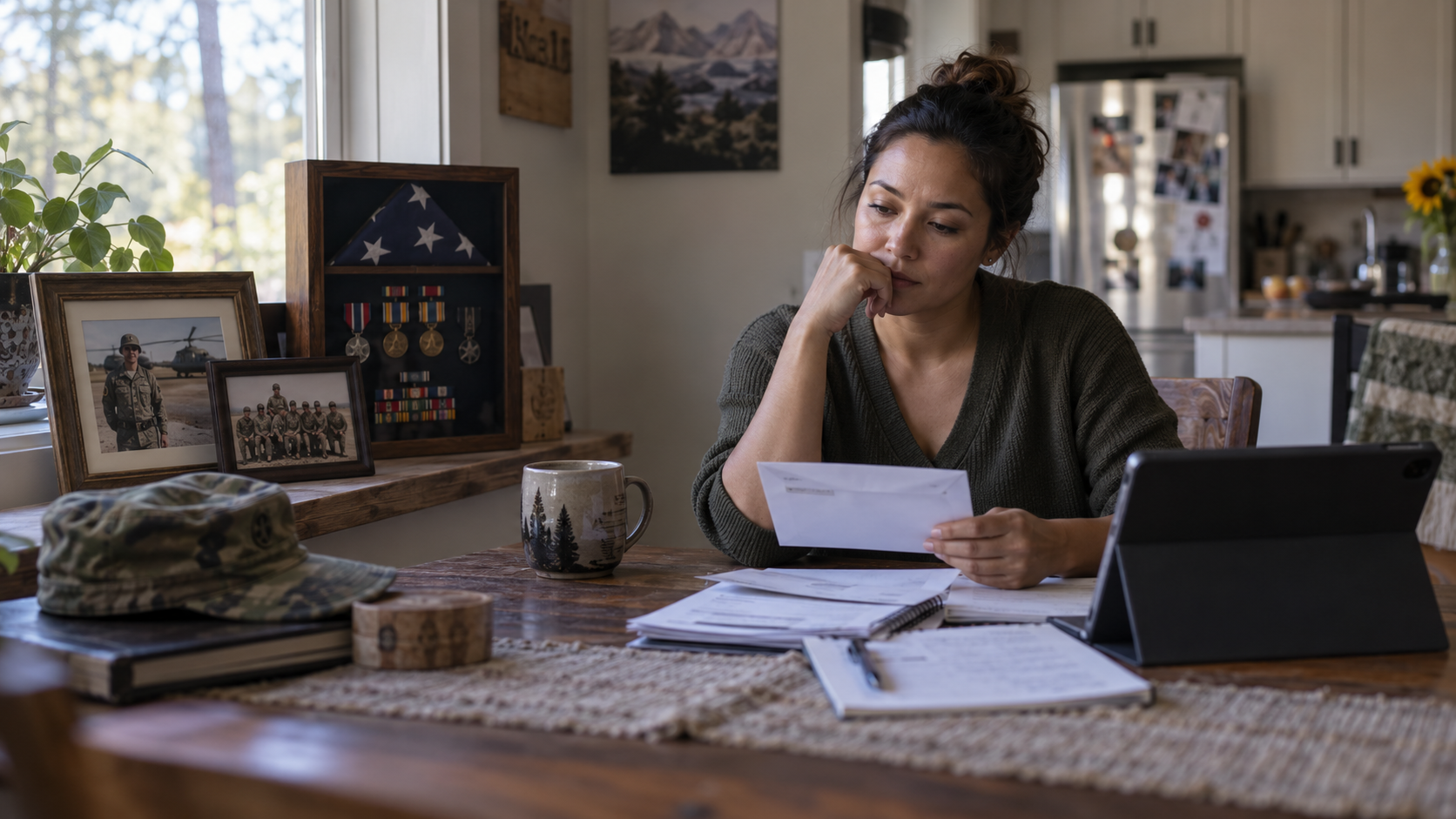
A woman sits alone with a memory she has never spoken aloud.
It visits her at night… in traffic, in grocery store lines, in the wee hours of the morning when she’d rather be asleep. She has learned to carry this weight the way you learn to carry anything heavy — by no longer noticing the heaviness.
Someone asks her if she’s ever gotten help.
"I'm fine," she says. "Other people have it worse." She believes this completely. She has believed it for years.
It never once occurred to her that believing she is managing might be an injury itself.
She was trained for this, in a way. Trained to notice everyone else's need before her own. Trained to be the one who is fine, so that others don't have to worry about her. It served her well, once. It earned her respect. Nobody told her how hard it would be to turn the training off.
So she does not ask for help. Not because no one cares about her, but because she has forgotten she deserves support. This is, in its way, what happens to women when they leave the military. The door to the VA is open and hers to walk through, but two out of every three women veterans never take that step past the threshold. It feels too hard to walk in.
When women veterans avoid the VA, it’s typically for the same reasons:
not knowing what they qualify for
not seeing themselves reflected in a system built around someone else
not wanting to take up space meant — they believe — for someone who needs it more
a lack of women-specific care
reports of harassment from strangers at VA facilities
a shortage of female providers
Not loud refusals. Quiet ones. The kind that don't show up as a complaint, only as an absence.
The fact deserves repeating: only about a third of women apply for the disability benefits they are owed — even that is progress; a decade ago it was closer to one in five. [¹]
Ironically, of the ones who do apply, almost nine in ten are approved by the VA. [²]
The waiting was never necessary; only the asking.
Long before she is a veteran, she is a service member. And before that, she is a recruit, standing in a line, being taught something no one says out loud. She is taught to endure. This is not unique to her — everyone in that line is taught to endure. But she is taught one thing more… to endure quietly, because to stand out is to invite a question no one wants to ask: does she belong here?
So she learns. She learns to carry more than her share and mention less than her share. She learns that complaining, even the ordinary kind, costs her something the men beside her do not have to pay. A reputation. A seat at the table. The benefit of the doubt.
By the time she is hurt — she has already had years of practice at holding it in. This is not weakness; it is a skill, drilled into her as surely as marksmanship or land navigation. She becomes excellent at it. She becomes so excellent that, one day, long after the uniform is folded away in a closet, she no longer notices how much she is still carrying.
Nobody trains a service member to stop enduring once their enlistment is over.
And so she carries it home. Into the grocery store line. Into the quiet time before sleep. Her wounds are often different in origin. Historically, 71% of women filing VA PTSD disability claims do so based on military sexual assault, whereas more than 90% of men file PTSD disability claims based on combat exposure. [³] A combat wound has a story that is easier to share at a dinner table than a rape or sexual assault. It asks something harder of the person carrying it — not just courage, but a willingness to risk not being believed — and, if she is believed, to face a secret that is now real and undeniable.
So she waits. Not because she was never hurt. Because the weight was manageable — until, one day, it wasn't. There is that moment — it comes differently for everyone, and there is no predicting when — where the weight simply changes. She notices, one ordinary day, that she has been carrying something for so long she has stopped remembering what it felt like to walk without it. And in that noticing, something small and necessary happens.
She asks.
Not because someone gave her permission. Not because the system finally deserved her trust. Because she could not carry it one more day, and some quiet, stubborn part of her — the same part that got her through everything else — decided she’d had enough.
Nine times out of ten, she is right to ask. [²] Not because the system owes her an apology — though it might — but because the door was never as heavy as it looked from the outside. Someone else has already walked through it. Then another. Then hundreds of thousands more, until what once felt like a lonely, unlikely chance became something closer to a certainty.
[¹] Rose L. Thayer, "More women are receiving disability benefits from VA than ever before," Stars and Stripes, March 21, 2024.
[²] U.S. Department of Veterans Affairs, "More than 50,000 women Veterans enrolled in VA health care over past 365 days," VA News, June 12, 2024.
[³] "Reversals in initially denied Department of Veterans Affairs' PTSD disability claims after 17 years: a cohort study of gender differences," PMC/NCBI (peer-reviewed).
_____________________________________________________________________________________________________________
If you recognized yourself in this — you are not alone, and you don't have to navigate this by yourself. I provide independent psychological evaluations for veterans throughout the VA disability process, based in New Mexico and licensed in Texas. If you're ready to take that first step, I'm here.